1st
Patient Safety Track, Columbia BME Hacking Health
48h
From concept to live prototype
2
Person team
The Problem We Chose
Triple Negative Breast Cancer (TNBC) is one of the most aggressive breast cancer subtypes, with limited targeted therapy options and disproportionately poor outcomes in underserved populations. A major bottleneck in TNBC care is clinical trial access: thousands of trials are actively enrolling, but oncologists lack tools to efficiently match individual patients to trials they are actually eligible for and likely to benefit from.
Patients, meanwhile, have almost no visibility into this landscape. They often rely entirely on their oncologist's awareness, which is constrained by time and the sheer volume of trial literature.
Where you go first is pretty important.
The Solution
Prognosight is a dual-interface decision support platform: one view for oncologists, one for patients.
The oncologist interface is a treatment simulator. A clinician enters a patient profile (age, ECOG status, tumor stage, comorbidities, prior treatments) and the system generates a ranked list of eligible clinical trials and standard-of-care pathways, with side-by-side outcome projections and toxicity tradeoffs.
The patient interface translates this into accessible language, explaining the patient's condition, available treatment options, and trial eligibility in plain terms. The goal was to close the information asymmetry between patients and the healthcare system.
The Ranking Engine
The core of the system is a weighted scoring engine. Each clinical trial in the database is scored against the patient profile across several dimensions: eligibility criteria match, projected outcome benefit (response rate, progression-free survival from published data), toxicity profile given the patient's comorbidities, and logistical factors.
The weights were defined based on literature review and clinical input gathered during the hackathon. A machine learning ranking model was identified as the natural next step; with enough patient outcome data, a learned ranking function would outperform the hand-crafted weights.
The 48-Hour Build
The platform was built from scratch in 48 hours by two people: Saha Dev handled the full-stack implementation, I drove the clinical framing, product architecture, and scoring logic design.
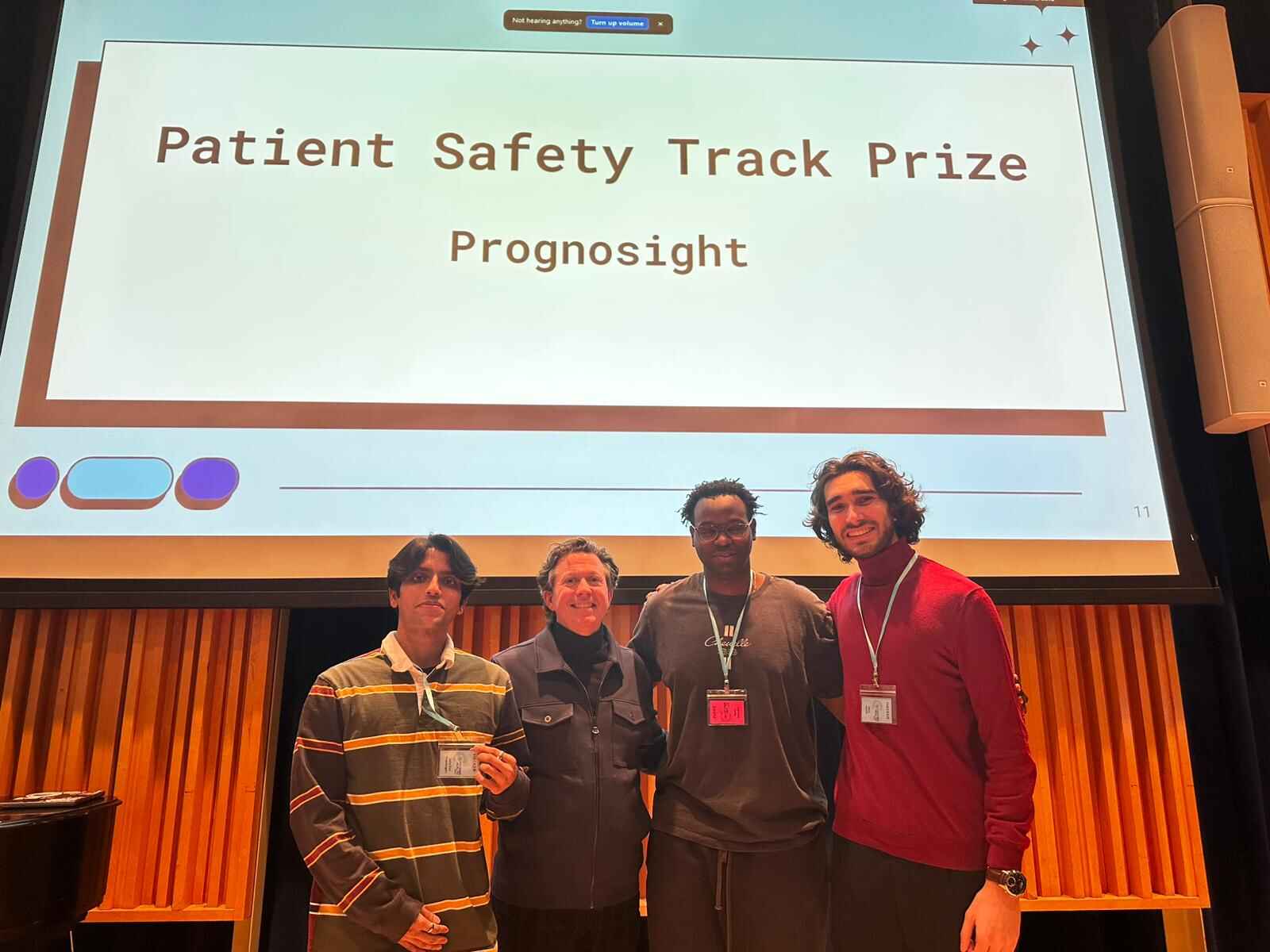
The system ran live as a functional prototype at judging. The jury selected Prognosight as the winner of the Patient Safety track for the quality of the clinical reasoning and the dual-interface design that addressed both physician efficiency and patient empowerment.
Regulatory Positioning
One of the first design decisions was determining whether the platform required FDA clearance at all. Under the 21st Century Cures Act, software that presents information for clinicians to independently review, without replacing clinical judgment, qualifies as non-device Clinical Decision Support and falls outside FDA jurisdiction.
Prognosight was deliberately architected to stay within this exemption: the physician retains full decision authority, the platform surfaces ranked options with transparent criteria, and no automated treatment decision is executed by the system. This shaped both the technical architecture and the business model: no FDA submission timeline, direct EHR integration pathway, and partnership structures with pharma and academic institutions rather than a cleared medical device go-to-market.
Final Report
The complete technical report behind Prognosight.
10pages · PDF