The Clinical Gap
Panic attacks are acute episodes of intense physiological arousal, with elevated heart rate, HRV suppression, and hyperventilation. About 4.7% of US adults experience panic disorder at some point in their lives, and 2.7% in any given year. Despite being physiologically measurable, episodes are almost never detected in real time. Current interventions are reactive: the patient recognizes the episode and manually initiates a coping protocol, often after the peak has passed, exactly when recalling a learned technique is hardest.
The opportunity is to detect the onset automatically, before the patient is overwhelmed, and deliver an immediate guided intervention, reducing episode severity and duration.
Device Architecture
The system was architected as an FDA Class II medical device under the de novo pathway, given that no substantially equivalent predicate exists for an autonomous panic attack detection and intervention wearable.
The device runs on Apple Watch, using two onboard sensors:
- Optical PPG for real-time heart rate and HRV measurement
- Accelerometer for motion detection (to distinguish panic-induced stillness from sleep or rest)
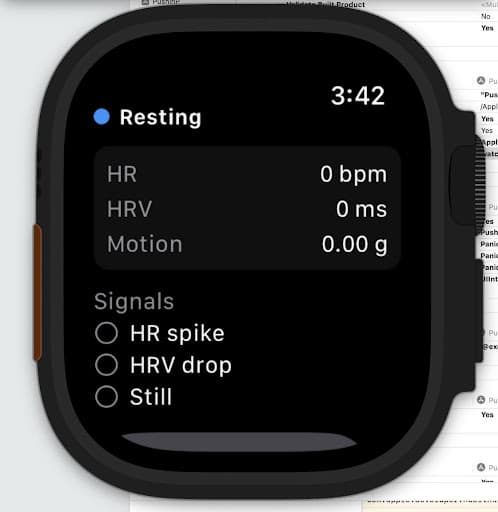
The detection algorithm looks for a physiological panic signature: a combination of thresholds that has to be true all at once.
≥ +20 bpm
Heart rate spike from baseline (PPG)
≤ 20 ms
HRV, via SDNN calculation (PPG)
≤ 0.2 g
Wrist acceleration, ruling out exercise (IMU)
> 80%
Target positive predictive value
Requiring elevated heart rate and suppressed HRV and near-stillness together is what separates a panic episode from exercise: an abnormal HR and HRV alone could mean anything, but combined with behavioral stillness they confirm panic rather than physical exertion. When all conditions are met, the system triggers the intervention automatically.
The Intervention
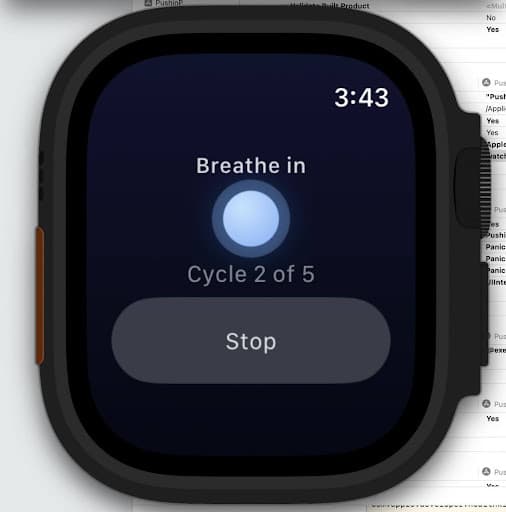
Once a panic state is detected, the device launches a guided breathing protocol without requiring user input. The screen shifts to a visual breathing coach ("Breathe in / Breathe out" with a pacing animation) and delivers synchronized haptic feedback.
The protocol runs for 5 cycles by default, with the option to extend. The design rationale: haptic and visual feedback is less socially visible than audio, making the intervention usable in professional or public settings without stigma. Discreteness and minimal social footprint were explicit design requirements.
Regulatory and Quality Framework
The device specification followed ISO 13485 Quality Management System requirements for medical device design controls: defined intended use, user profile, use environment, and risk analysis following ISO 14971. Classified as Class II Software as a Medical Device, the device targets the De Novo pathway, since no sufficiently similar predicate exists for autonomous panic detection paired with a CBT intervention. The closest cleared devices are Freespira (K180173) and Daylight by Big Health (K233872).
The target performance specification was greater than 80% Positive Predictive Value, meaning fewer than 1 in 5 alerts would be a false positive. At this PPV level, the intervention remains clinically credible and user trust in the system is maintained. Guided breathing is a first-line CBT tool for panic, and triggering it within 30 seconds of detection is what makes it useful before the patient is overwhelmed.
The prototype was validated as a functional concept with a working watchOS simulator. Clinical validation on real physiological data during induced stress conditions was defined as the required next step before any regulatory submission.
Final Report
The complete technical report behind Panic Attack Detection.
17pages · PDF