The Clinical Context
Endovascular Aneurysm Repair (EVAR) is a minimally invasive procedure to treat aortic aneurysms. Surgeons navigate a stent-graft through the femoral artery to the aorta, guided by imaging alone. The procedure demands high tactile precision: the surgeon must feel the compliance of the aortic wall to correctly position and deploy the stent without rupture.
Training simulators for EVAR exist, but most use silicone or latex vessels with mechanical properties that poorly match real aortic tissue. The goal of this project was to design a bio-mimetic aortic wall that replicates the mechanical compliance of human tissue, to be integrated into a full EVAR training simulator developed by a PhD researcher at LMPS.
The Design Approach
The key insight was that aortic tissue compliance cannot be replicated by a homogeneous material alone. The aortic wall is built from three layers: an intima of connective tissue, a media of elastin networks, and an adventitia of collagen fibers that resist extreme deformation. That layered organization makes the wall anisotropic, stiffer circumferentially and more compliant longitudinally, and a deficiency in fibrillin-1 production is one of the pathways that alters vascular physiology and raises aneurysm risk.
My approach was to design a parametric woven mesostructure: a repeating geometric lattice pattern, printed in a bi-material combination, that mimics this anisotropy at the structural level rather than relying on bulk material properties alone.
Bi-material print system (Stratasys PolyJet)
- Rigid strands
- Vero, 50 to 60 MPa tensile strength
- Compliant matrix
- Agilus 30, 2.4 to 3.1 MPa tensile, 220 to 270% elongation
- Tunable parameters
- Pitch, strand width, interlocking angle
- Minimum feature
- 0.3 mm (printer resolution target)
Simulation and Validation
The mesostructure geometry was modeled in SolidWorks as a fully parametric design, with pitch, strand width, and interlocking angle all adjustable independently to tune the effective stiffness.
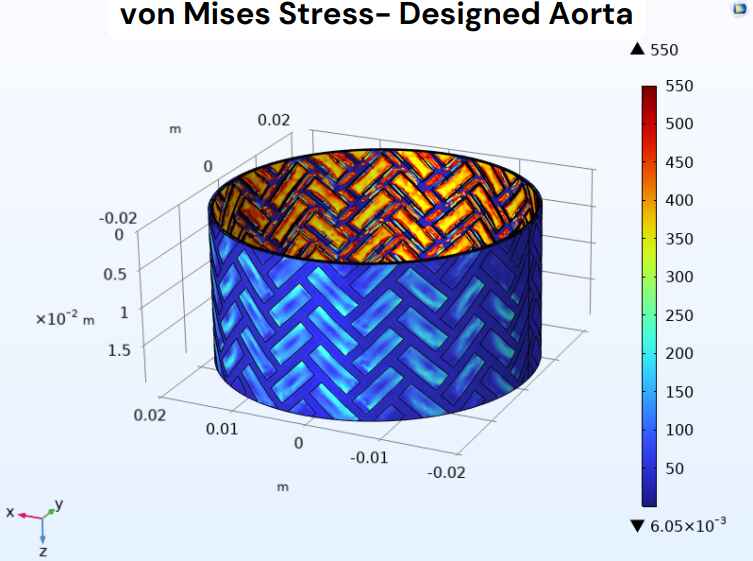
FEA simulation in COMSOL modeled Von Mises stress and deformation under physiological loads, with a 40 mm vessel, an intraluminal pressure around 160 mmHg and abdominal pressure around 12 mmHg, using a non-Newtonian power-law blood model. Comparing the designed wall against a reference aorta confirmed that the woven architecture distributes stress more uniformly than a solid wall, reducing peak stress concentrations at the vessel boundary conditions.
Material Calibration
The physical validation used a Stratasys PolyJet printer with a bi-material approach: VeroRigid for the structural strands and AgilusBlack for the compliant matrix. Calibration prints were fabricated to characterize the printer's resolution at 0.3 mm (the minimum feature size) and determine the optimal material ratio.
The fabricated samples demonstrated that the mesostructure can be reliably printed at the target resolution, validating the manufacturing feasibility of the design. Integration into the full EVAR simulator and in-vitro pressure testing remain as next steps.
Final Report
The complete technical report behind EVAR Aortic Simulator.
23pages · PDF · 16 MB